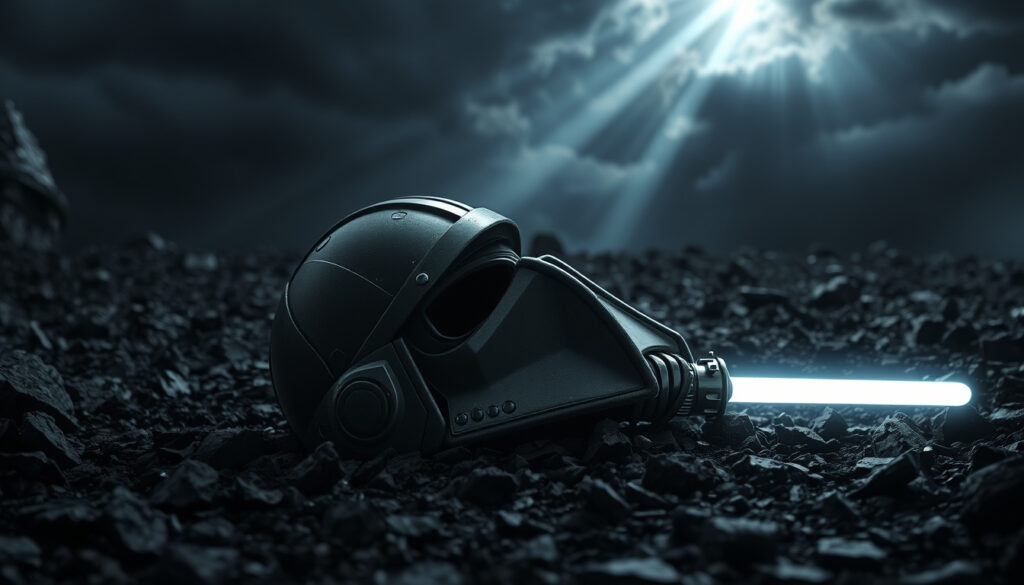
Darth Vader: Villain, Hero, and Anakin’s Tragic Fall
Few characters in film history spark as much fascination as the man in the black mask. Darth Vader is a figure who commands both terror and sympathy, a villain whose final act redeems him in the eyes of millions.
First film appearance: 1977’s Star Wars ·
Original actor (body): David Prowse ·
Voice actor: James Earl Jones ·
Character’s real name: Anakin Skywalker ·
Turn to dark side: 19 BBY
Quick snapshot
- Widely seen as a top villain (Superneox – pop culture analysis)
- Redemptive arc complicates label (ScreenRant – Star Wars commentary)
- AFI’s #3 villain (Wikipedia – AFI list)
- No explicit film remorse (ScreenRant – Star Wars commentary)
- Expanded universe hints at guilt (Superneox – pop culture analysis)
- Redemption driven by son (The Direct – official timeline)
- Manipulated by Palpatine (ScreenRant – timeline explainer)
- Feared losing Padmé (ScreenRant – Star Wars commentary)
- Massacred Jedi Temple (The Direct – official timeline)
- Instrumental in Great Jedi Purge (ScreenRant – timeline explainer)
- Order 66 killed most (Pop Culture Weekly – timeline summary)
- High personal tally (ScreenRant – Star Wars commentary)
Seven key facts about Darth Vader, one pattern: his story is defined by transformation — from chosen one to enforcer, then to redeemer.
| Attribute | Value |
|---|---|
| First film appearance | 1977’s Star Wars (ScreenRant – timeline explainer) |
| Original actor (body) | David Prowse (Wikipedia – David Prowse) |
| Voice actor | James Earl Jones (Wikipedia – James Earl Jones) |
| Character’s real name | Anakin Skywalker (ScreenRant – timeline explainer) |
| Number of live-action film appearances | 5 (Episodes III, IV, V, VI, Rogue One) (Wikipedia – Darth Vader) |
| Turn to dark side | 19 BBY (The Direct – official timeline) |
| Death | 4 ABY (The Direct – official timeline) |
Is Darth Vader a villain or a hero?
Villainous actions and legacy
Darth Vader is widely considered one of cinema’s greatest villains. The American Film Institute ranked him the third-greatest film villain in history (Wikipedia – AFI list). His list of atrocities includes ordering the destruction of an entire planet, personally killing countless Jedi, and enforcing the Empire’s tyranny for two decades.
“I am altering the deal. Pray I don’t alter it any further.”
Darth Vader, The Empire Strikes Back (Superneox – quotes archive)
Vader’s villainy is beyond dispute on screen, but the character’s arc forces audiences to weigh his monstrous acts against a single moment of sacrifice.
Heroic redemption in Return of the Jedi
In the climax of Return of the Jedi, Vader watches his son Luke being tortured by Emperor Palpatine. He turns on his master, throwing Palpatine down a reactor shaft, and suffers fatal injuries in the process (The Direct – official timeline). Luke refuses to kill him, and Vader’s final words — “Tell your sister… you were right” — are widely treated as a redemption marker (Superneox – quotes archive).
George Lucas himself has endorsed the fall-and-redemption reading of Vader’s six-episode arc (Eleven-ThirtyEight – analysis). The implication: Vader’s story is less about pure evil and more about a man who ultimately chooses family over power.
Public perception and cultural impact
Fans and critics remain divided. Some argue that killing Emperor Palpatine does not erase the slaughter of children and billions of sentient beings. Others see the redemption as the emotional core of the saga. A common interpretation of the first six films is that they tell the fall and redemption of Darth Vader (Eleven-ThirtyEight – analysis). The trade-off: Vader remains a villain by deed, but a tragic hero by narrative structure.
What made Darth Vader evil?
The fall of Anakin Skywalker
Anakin Skywalker was introduced in The Phantom Menace as the Chosen One of Jedi prophecy (ScreenRant – timeline explainer). He turned to the dark side because of his fear of losing Padmé Amidala (ScreenRant – Star Wars commentary). Attachment, forbidden by the Jedi Code, became the seed of his corruption.
The influence of Emperor Palpatine
Palpatine manipulated Anakin over many years, exploiting his distrust of the Jedi and his desire for power to save Padmé (ScreenRant – timeline explainer). After Anakin’s turn, he served as Palpatine’s right-hand enforcer for years (ScreenRant – timeline explainer). Evil was not innate in Anakin; it was cultivated.
Key traumatic events
The massacre of the Jedi Temple and the younglings was a definitive point of no return (The Direct – official timeline). Shortly after, during a duel on Mustafar, Anakin was dismembered by Obi-Wan Kenobi and left for dead. Palpatine rebuilt him in the iconic black armor (The Direct – official timeline). The physical transformation mirrored the spiritual one.
Anakin’s fall is often framed as a tragedy of good intentions — he wanted to save his wife and ended up destroying everything he loved. The line between victim and perpetrator is deliberately blurred.
Why is he called Darth Vader?
Origin of the name in the Star Wars galaxy
“Darth” is a title used by Sith Lords, meaning “Dark Lord of the Sith” (Wikipedia – Darth Vader). The name “Vader” was given to Anakin after his turn to the dark side. He had previously been known only as Anakin Skywalker.
Real-world inspiration and etymology
George Lucas has stated that “Vader” may be derived from the Dutch word “vader,” meaning “father” (Wikipedia – Darth Vader). This etymology fits the reveal in The Empire Strikes Back that Darth Vader is Luke’s father. The name was created long before the prequels, making the fatherhood connection a happy accident or a deeply layered choice — either way, it became one of the most famous names in cinema.
What this means: The name carries a double meaning — a Sith title and a hidden family truth.
Did Darth Vader regret killing younglings?
Evidence of regret in canon
In the films, Vader shows no explicit remorse for the massacre at the Jedi Temple. He never mentions it, never questions it. However, expanded universe material — including comics and novels — suggests lingering guilt from Anakin’s past (Superneox – pop culture analysis). The canon itself is silent on the matter.
The role of Anakin’s internal conflict
Anakin’s internal conflict is central to his story, but where it surfaces is telling. In Return of the Jedi, his redemption is driven by love for his son — not by regret for past atrocities (The Direct – official timeline). His final act is about saving Luke, not atoning for younglings.
Comparison with other remorseful Sith
Compared to characters like Darth Maul or Count Dooku, Vader’s arc is unique in allowing redemption. Yet the question of whether he truly regretted the youngling killings remains open. Fan debates continue, and canon leaves room for interpretation (Superneox – pop culture analysis). The pattern: the more you dig, the less clear the answer becomes.
Who has killed the most Jedi?
Darth Vader’s kill count
Darth Vader personally killed numerous Jedi during the Great Jedi Purge. While exact numbers are unconfirmed in canon, his individual tally is exceptionally high (ScreenRant – Star Wars commentary). Anakin Skywalker, as Darth Vader, is often cited as having the highest personal kill count among Sith.
Other Sith and Jedi who killed many Jedi
Other Sith like Darth Maul and Count Dooku also killed multiple Jedi, but none matched Vader’s volume (ScreenRant – timeline explainer). The difference is not just skill — Vader had years of relentless hunting during the Empire’s reign.
Order 66 and its impact
Emperor Palpatine orchestrated Order 66, which killed most Jedi across the galaxy (Pop Culture Weekly – timeline summary). Vader was instrumental in executing the purge, but the bulk of the casualties came from clone troopers turning on their generals. Vader was the Empire’s sharpest weapon, but the death toll belongs to the entire regime.
The implication: Vader’s individual kill count is high, but the genocide was a system-wide effort.
Timeline of Darth Vader’s life
- 32 BBY – Anakin Skywalker is born on Tatooine (ScreenRant – timeline explainer).
- 22 BBY – Anakin begins Jedi training under Obi-Wan Kenobi (ScreenRant – timeline explainer).
- 19 BBY – Anakin turns to the dark side, becomes Darth Vader, and is severely injured on Mustafar (The Direct – official timeline).
- 0 BBY – Darth Vader is introduced in Star Wars: A New Hope (Wikipedia – Darth Vader).
- 3 ABY – Reveals to Luke Skywalker that he is his father (Superneox – quotes archive).
- 4 ABY – Darth Vader redeems himself and dies after killing Emperor Palpatine (The Direct – official timeline).
Clarity check: what we know and what remains uncertain
Confirmed facts
- Darth Vader is the alter ego of Anakin Skywalker.
- He was a Jedi Knight who turned to the dark side.
- He killed younglings at the Jedi Temple.
- He redeemed himself by killing Palpatine.
What’s still unclear
- Exact number of Jedi killed by Vader personally.
- Whether Vader truly regretted killing younglings or acted under manipulation.
- The full extent of his internal conflict during his time as a Sith.
Quotes that define a legacy
“I am your father.”
Darth Vader, The Empire Strikes Back (Superneox – quotes archive)
“The ability to destroy a planet is insignificant next to the power of the Force.”
Darth Vader, A New Hope (Reddit r/StarWars – fan discussion)
“You were the Chosen One! It was said that you would destroy the Sith, not join them!”
Obi-Wan Kenobi, Revenge of the Sith (Wikiquote – Darth Vader)
“Your overconfidence is your weakness.”
Darth Vader, A New Hope (Superneox – quotes archive)
The bigger picture
Darth Vader’s story is not a simple arc. He is a villain who commits genocide, yet his final choice — to save his son — reframes everything that came before. For modern audiences, the question is not whether Vader was evil; it is whether evil can be undone. The pattern from Star Wars is clear: redemption requires sacrifice. For fans debating his legacy, the implication is that Vader remains the most human villain in cinema — a man who lost everything and found one reason to return.
Related reading: Anakin Skywalker and Darth Vader timeline explained · Darth Vader official Star Wars timeline
youtube.com, youtube.com, podcast.popcultureweekly.com, reddit.com, ranker.com
En utförlig analys av Darth Vader som tragisk hjälte belyser varför hans resa från lärling till Sith Lord fortsätter att fascinera fansen.
Frequently asked questions
What is Darth Vader’s lightsaber color?
Red. The red blade is the hallmark of a Sith Lord, symbolizing synthetic crystals created through dark side corruption (Wikipedia – Darth Vader).
How did Darth Vader get his suit?
After his defeat on Mustafar, Emperor Palpatine had him rebuilt with life-support armor. The suit maintains his damaged body and amplifies his physical strength (The Direct – official timeline).
What are Darth Vader’s powers?
As a Sith Lord, Vader has telekinesis, Force choke, precognition, and lightsaber combat mastery. He is one of the most powerful Force users in the galaxy (Wikipedia – Darth Vader).
Is Darth Vader the most popular villain?
According to multiple polls and the AFI list, he ranks among the top three most iconic villains in film history (Wikipedia – AFI list).
How tall is Darth Vader?
Vader is portrayed as towering — actor David Prowse was 6’7″ (201 cm), and the costume adds to the imposing presence (Wikipedia – Darth Vader).
What is Darth Vader’s theme song?
“The Imperial March” by John Williams — one of the most recognizable villain themes in cinema (Wikipedia – The Imperial March).
Why does Darth Vader breathe loudly?
The breathing sound comes from his life-support system, which he needs after his lungs were damaged on Mustafar. The sound emphasizes his mechanical dependency (The Direct – official timeline).
Does Darth Vader have any children besides Luke and Leia?
In canon, Luke Skywalker and Leia Organa are his only biological children. Expanded universe material once included other offspring, but those are now Legends (Wikipedia – Darth Vader).
More related posts
 Highway 11 Shelter-in-Place: Closure Details and Map
 Theodore Roosevelt: Biography, Presidency & Legacy
 Kieran Culkin: Biography, Family, and Career Facts
 Rajasthan Royals vs Gujarat Titans Timeline: IPL Head-to-Head
 Courtney Love’s Autism Diagnosis, Sobriety, Life Abroad
 Normal Blood Pressure: What It Means by Age
 Pakistani Chapli Kebab Near Me: Best Dublin Restaurants
 Ned Flanders: Catchphrase, Religion, and Character Analysis