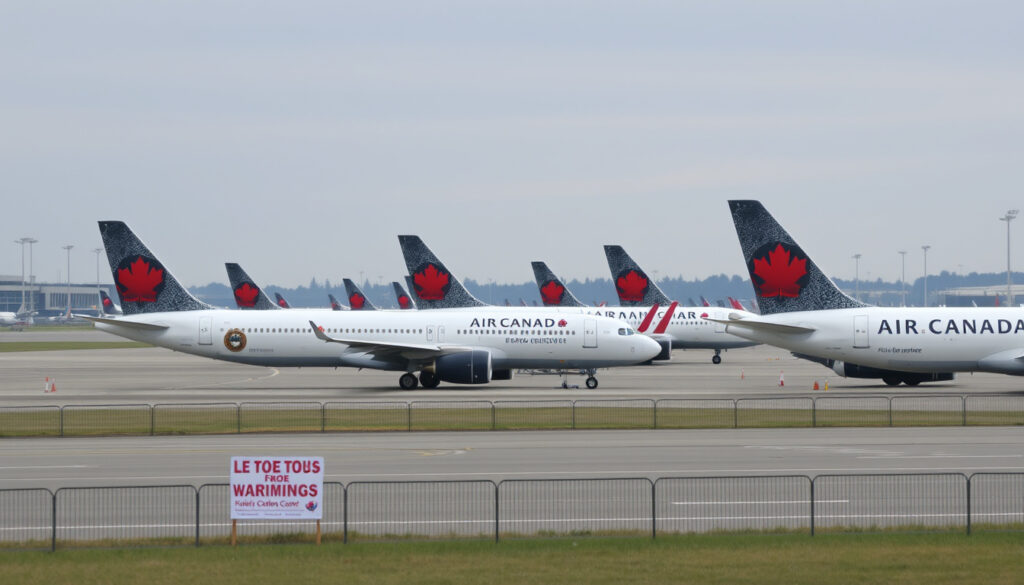
Air Canada Grève 2025 – Dates, Unions, Impacts & Status
The 2025 Air Canada flight attendants strike emerged as one of the most significant labour disruptions in Canadian aviation history, affecting hundreds of thousands of travellers and costing the airline hundreds of millions in lost revenue. The four-day work stoppage by 10,517 flight attendants represented by the Canadian Union of Public Employees (CUPE) created widespread chaos across Air Canada’s domestic, transborder, and international networks.
The dispute centred on compensation demands that union officials argued fell short of market standards and inflation rates. Following months of unsuccessful negotiations, flight attendants walked off the job on August 16, 2025, eventually returning after a tentative agreement was reached. However, the resolution proved temporary when union members overwhelmingly rejected the proposed wage terms in a subsequent ratification vote, leaving fundamental issues unresolved as mediation proceedings continued into September 2025.
Is Air Canada on Strike in 2025?
Mediation ongoing; no active strike as of September 6, 2025
CUPE (Canadian Union of Public Employees) representing 10,517 flight attendants
August 16–19, 2025 (four days)
Air Canada and Air Canada Rouge operations disrupted; Express services continued
- More than half a million passengers experienced disrupted travel plans during the four-day work stoppage
- Air Canada reported approximately C$430 million in lost revenue attributable to the strike
- The tentative agreement reached on August 19 was rejected by 99.1 percent of voting union members
- Government-mandated binding arbitration and a return-to-work order were defied by the union
- The previous collective bargaining agreement had remained in effect for ten years before expiring in March 2025
- Air Canada conceded to pay flight attendants for groundwork duties, a first for the carrier
- Both parties agreed that no further labour disruption would occur while mediation proceeds
| Fact | Details | Source |
|---|---|---|
| Company | Air Canada | Corporate |
| Event | Flight attendants labour strike | Corporate |
| Year | 2025 | Corporate |
| Workers involved | 10,517 flight attendants | CUPE |
| Union representing | Canadian Union of Public Employees (CUPE) | CUPE |
| Duration | 4 days (August 16–19) | Corporate |
| Cancellations | 3,200 flights | Corporate |
| Revenue impact | C$430 million lost | Corporate |
| Passengers affected | Over 500,000 | Corporate |
When Did the Air Canada Strike Occur in 2025?
The work stoppage began in the early hours of August 16, 2025, when flight attendants represented by CUPE walked off the job at 00:58 EDT. This action came after months of contract negotiations that had failed to produce a mutually acceptable agreement. The previous collective bargaining agreement had been in place for a decade before expiring in March 2025, leaving the two sides without a framework for wages and working conditions.
After four days of picketing and operational disruptions, a tentative deal was announced on August 19 following nine hours of overnight negotiations facilitated by a government-appointed mediator. The agreement provided a pathway to resume normal operations, and flight attendants returned to work as the airline began the lengthy process of rebuilding its schedule.
Key Dates in the Labour Dispute
- March 2025: Previous 10-year collective bargaining agreement expires
- August 16, 2025, 00:58 EDT: Strike begins; 10,517 flight attendants walk off the job
- August 17, 2025, 14:00 EDT: Canada Industrial Relations Board issues return-to-work order
- August 19, 2025: Tentative agreement reached after overnight mediation talks
- August 27 – September 6, 2025: Ratification vote conducted among union members
- September 6, 2025: Vote results announced; mediation continues over outstanding issues
The ratification vote saw exceptionally high participation, with 99.4 percent of eligible members casting ballots. Of those, 99.1 percent voted against the proposed wage package, reflecting deep dissatisfaction with the compensation offer despite the union leadership’s recommendation to accept the deal.
Which Unions and Employees Were Involved?
The Canadian Union of Public Employees (CUPE) represented the striking workers, specifically its Air Canada component. CUPE Local 4094 negotiated on behalf of 10,517 flight attendants across all cabin classes and route types operated by Air Canada and its low-cost subsidiary Air Canada Rouge.
The pilot union, the Air Canada Pilots Association (ACPA), was not involved in this particular dispute. While pilots at other carriers have engaged in contract talks during 2025, the Air Canada pilot group remained outside this labour conflict, focusing on their own separate negotiations that were ongoing but distinct from the flight attendants’ work stoppage.
Scope of Affected Operations
The strike disrupted all flights operated under the Air Canada and Air Canada Rouge brand. This included mainline domestic services, transborder routes to the United States, and international destinations across the Atlantic and Pacific. Passengers holding tickets for affected flights faced cancellations, significant delays, or the need to rebook with alternative carriers.
Notably, regional services operated under the Air Canada Express banner by Jazz Aviation and PAL Airlines continued operating normally throughout the dispute. These aircraft are operated by crew members who hold different employment relationships and were not part of the CUPE bargaining unit.
How Did the Strike Impact Flights and Travelers?
The disruption caused by the four-day work stoppage proved substantial. Air Canada cancelled approximately 3,200 flights during the strike period, representing a significant portion of its scheduled operations. The airline’s chief operations officer later estimated that over 100,000 Canadians found themselves stranded away from their home destinations, requiring the carrier between seven and ten days to restore normal flight frequencies after the work stoppage ended.
The financial toll on the airline proved equally severe. Air Canada recorded approximately C$430 million in lost revenue directly attributable to the strike, encompassing cancelled ticket sales, passenger rebooking costs, and the expense of accommodating travellers with partner airlines. The impact extended beyond the immediate disruption period as the carrier worked to rebuild customer confidence and operational reliability.
According to statements from Air Canada’s chief operations officer, normal operations required between seven and ten days to resume following the strike’s conclusion on August 19, 2025.
Passenger Rights and Refund Options
Travellers whose flights were cancelled due to the strike became eligible for refunds under Canada’s Air Passenger Protection Regulations. Passengers had the option to receive a refund to the original payment method for cancelled flights, even for non-refundable tickets, when the cancellation fell outside the airline’s control. Those who needed to make alternative travel arrangements could submit receipts for reasonable expenses incurred due to the disruption.
Air Canada established dedicated customer service resources to handle the surge in requests, though wait times were lengthy during the immediate aftermath as the airline processed thousands of rebooking and refund applications alongside its regular customer volume.
What Caused the Air Canada Labour Dispute?
The fundamental disagreement centred on compensation. Air Canada put forward an offer of a 38 percent increase in total compensation over four years, with 25 percent of that increase taking effect in the first year. Union negotiators rejected this proposal, characterizing it as inadequate given prevailing economic conditions and comparable compensation at competing airlines.
CUPE officials publicly described the offer as “below inflation, below market value, below minimum wage.” The union had been engaged in negotiations for more than eight months before the work stoppage began, seeking compensation levels that would bring Air Canada flight attendants in line with their peers at other Canadian carriers.
Wage Parity Demands
A central objective of the union’s bargaining position involved achieving wage parity with flight attendants at Air Transat. That airline’s 2024 contract negotiations resulted in a new agreement that positioned Air Transat cabin crew as the highest-paid flight attendants in Canada, creating a benchmark that CUPE sought to match for its Air Canada members.
The disparity argument gained traction among union members, many of whom pointed to the cost of living in Canadian cities where crew bases are located and the demanding nature of the work as justification for higher compensation. The contract void created by the March 2025 expiration added urgency to negotiations, as both sides operated without a binding agreement for the first time in a decade.
Air Canada’s agreement to pay flight attendants for groundwork duties represented a significant policy change. Industry analysts noted this concession could influence future negotiations at other North American carriers, including WestJet, where CUPE indicated it would raise similar demands.
What Was the Government Response?
Federal Jobs Minister Patty Hajdu intervened by imposing binding arbitration on the dispute. The Canada Industrial Relations Board simultaneously issued a return-to-work order at 14:00 EDT on August 17, 2025, compelling flight attendants to resume their duties while negotiations continued under a legal framework.
The union refused to comply with the board’s order, declaring the mandatory arbitration and return-to-work provisions unconstitutional. CUPE maintained that compelling workers to labour during a legal strike represented an infringement of constitutional rights, a position that placed the union in direct conflict with federal labour authorities. The defiance carried potential legal consequences for the union and its leadership, though the strike concluded before such matters could be fully adjudicated.
CUPE described the government’s intervention as “below inflation, below market value, below minimum wage” in its public statements rejecting the proposed settlement terms.
What Remains Confirmed and Uncertain?
| Established Information | Information That Remains Unclear |
|---|---|
| The strike occurred August 16–19, 2025 | Specific financial penalties imposed for defying the return-to-work order |
| 10,517 flight attendants walked off the job | Timeline for final resolution through arbitration if mediation fails |
| 3,200 flights were cancelled | Whether the groundwork pay policy will be extended to other carriers |
| C$430 million in lost revenue recorded | Impact on Air Canada’s long-term labour relations strategy |
| 99.1% of voting members rejected the tentative agreement | Future contract demands once current negotiations conclude |
| Mediation is ongoing as of September 6, 2025 | Whether pilot negotiations will follow a similar pattern |
Both parties have agreed that flights will continue operating with no strike or lockout permitted while mediation proceeds. If mediation fails to resolve the outstanding wage disputes, the matter will proceed to arbitration under the terms imposed by the Canada Industrial Relations Board.
What Is the Current Status?
As of September 6, 2025, Air Canada and CUPE remained engaged in mediation over the outstanding issues from the failed tentative agreement. The wage portion of the proposed deal was decisively rejected by union members, yet both sides agreed that normal flight operations would continue without the threat of further labour disruption during the mediation period.
The framework established after the ratification vote results ensures passengers can book Air Canada flights with confidence that operations will continue through at least the arbitration process. Should mediation prove unsuccessful, binding arbitration will determine the final contract terms, bringing the extended labour dispute to a conclusion through a process imposed by the Canada Industrial Relations Board.
The dispute has drawn attention to working conditions and compensation standards across the Canadian aviation sector. CUPE’s indication that it would pursue groundwork pay at WestJet and other carriers suggests the resolution of this conflict may influence labour relations throughout the industry for years to come. Economic pressures facing both airlines and aviation workers continue to shape negotiations, with inflation, labour shortages, and travel demand all factoring into contract discussions.
Sources and Official Statements
Official information about the labour dispute came from multiple sources representing the airline, the union, and federal government bodies responsible for labour relations oversight in federally regulated industries such as aviation.
“Air Canada and CUPE head to mediation over outstanding issue.” Official statement from Air Canada corporate communications, confirming the agreement that flights would continue operating while negotiations proceed through mediation or arbitration.
CUPE provided regular updates through its public communications channels, outlining the union’s bargaining priorities and its legal position regarding the government’s intervention. The Canada Industrial Relations Board issued formal orders and decisions that were matters of public record through the Crown corporation’s official publications.
Industry coverage drew upon statements from Air Canada’s chief operations officer regarding the operational impact and recovery timeline, as well as labour market analysts who assessed the broader implications of the groundwork pay concession for North American airline employment practices.
Summary and Ongoing Developments
The 2025 Air Canada flight attendants strike demonstrated the intensity of labour tensions in Canada’s aviation sector, where workers sought compensation increases to match inflation and competitive benchmarks set by rival carriers. The four-day disruption cancelled over three thousand flights, affected more than half a million passengers, and cost the airline hundreds of millions in lost revenue. While a tentative agreement ended the immediate work stoppage, union members’ decisive rejection of the wage terms signalled that fundamental issues remained unresolved.
The current mediation phase represents the final attempt at negotiated settlement before binding arbitration imposes a resolution. Travellers can expect Air Canada operations to continue without disruption through this process, though the ultimate terms of the new collective agreement will depend on the outcome of either mediation or arbitration proceedings.
The conflict has already produced lasting changes, including Air Canada’s commitment to pay flight attendants for groundwork duties. How this precedent influences negotiations at other Canadian carriers, and whether similar disputes emerge as pilots and other employee groups pursue their own contract renewals, remain questions that will shape the aviation labour landscape in the months and years ahead. For more on how this labour dispute fits within broader economic and political dynamics in Canada, explore our analysis of Mark Carney vs Pierre Poilievre and recent Canadian Citizenship Law Changes.
Frequently Asked Questions
When exactly did the Air Canada flight attendants strike occur in 2025?
The strike began at 00:58 EDT on August 16, 2025, and ended on August 19, 2025, when a tentative agreement was reached after nine hours of overnight mediation talks.
How many flights were cancelled during the strike?
Air Canada cancelled approximately 3,200 flights during the four-day work stoppage, affecting over 500,000 passengers.
Which union represented the striking flight attendants?
The Canadian Union of Public Employees (CUPE) represented 10,517 flight attendants. The Air Canada Pilots Association was not involved in this dispute.
What compensation increase was offered and rejected?
Air Canada offered a 38 percent total compensation increase over four years, with 25 percent in the first year. Union members rejected this with 99.1 percent voting against the deal.
Are flights currently operating normally?
Yes. As of September 6, 2025, both parties agreed that flights would continue operating with no strike or lockout permitted while mediation proceeds.
What happens if mediation fails to resolve the dispute?
If mediation is unsuccessful, the matter proceeds to binding arbitration, which will determine the final contract terms under the framework imposed by the Canada Industrial Relations Board.
Can passengers get refunds for flights cancelled during the strike?
Yes. Under Canada’s Air Passenger Protection Regulations, passengers whose flights were cancelled due to the strike are eligible for refunds to their original payment method.
What was the financial impact on Air Canada?
Air Canada recorded approximately C$430 million in lost revenue directly attributable to the strike, and the chief operations officer estimated over 100,000 Canadians were stranded during the disruption.
More related posts
 How Many Ounces in a Cup? Dry vs Liquid US & UK Guide
 Transition Words for Essay – Improve Flow and Coherence
 Pork Chops in Air Fryer: Times, Temps & Juicy Tips
 Michelle Monaghan Movies and TV Shows – Full Filmography Guide
 Winter Spring Summer or Fall: Streaming Guide, Rating & Review
 How to Book Cheap Hotels in Ireland: Tips and Sites
 Bonnie Blue Petting Zoo – Controversy and OnlyFans Ban
 Scary Stories to Tell in the Dark – Tales, Bans and Movie Guide