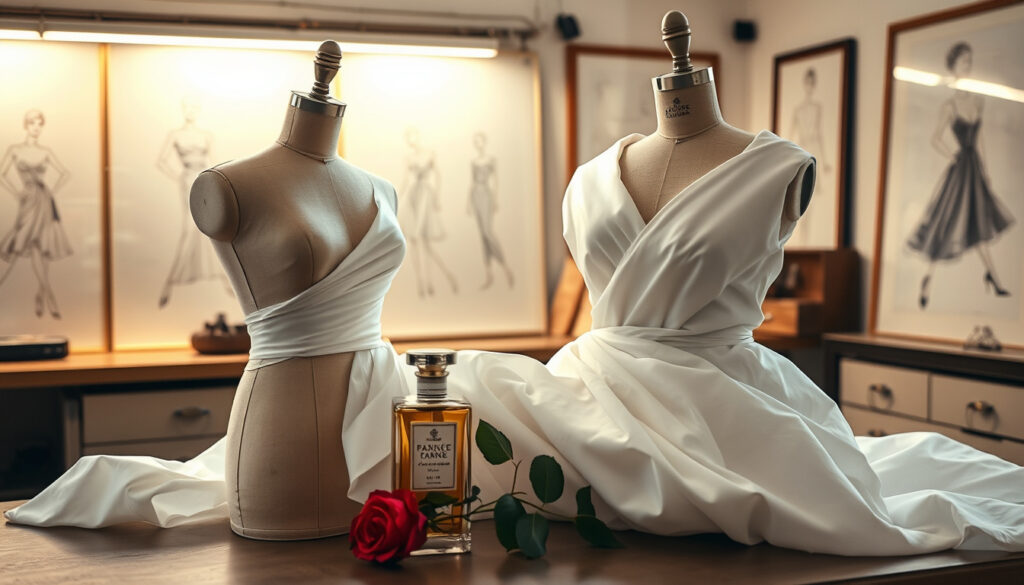
Christian Dior: Life, Legacy & Chanel Rivalry
Christian Dior’s name carries weight because of the story behind the dresses — a shy art dealer from Normandy who built a post-war empire. His life was as dramatic as the silhouette he invented, and the house endures because of untold family sacrifices, bitter rivalry with Coco Chanel, and a quietly kept personal story.
Founded: 1946 · Headquarters: Paris, France · Founder: Christian Dior · Founder’s Death: 1957 · Key Creation: New Look (1947) · Parent Company: LVMH
Quick snapshot
- Dior founded in 1946 with backing from Marcel Boussac (Encyclopaedia Britannica, academic reference work)
- First collection (New Look) debuted February 1947 (Elle Decor, design and lifestyle magazine)
- Catherine Dior was tortured and sent to Ravensbrück (Encyclopaedia Britannica)
- Dior died of a heart attack in 1957 (Encyclopaedia Britannica)
- Exact details of Dior’s relationship with Jacques Benita remain private — accounts vary on how long they were together (Natasha Lester, historical writer)
- Whether the Chanel‑Dior feud was primarily personal or professional: historical sources conflict (Natasha Lester, historical writer)
- Full extent of Catherine Dior’s Resistance network activities is still pieced together from memoirs (Natasha Lester, historical writer)
- 1905: Christian Dior born
- 1946: House of Dior founded
- 1947: New Look transforms fashion
- 1957: Yves Saint Laurent succeeds Dior
- 2016: Maria Grazia Chiuri becomes first female creative director
- Dior continues as a flagship brand of LVMH
- Chiuri’s runway pushes feminist narratives forward
- Media interest in the Dior vs Chanel rivalry and Miss Dior story grows
Seven key facts frame the Dior narrative, and one pattern: the man and the brand are inseparable.
| Fact | Detail |
|---|---|
| Full Name | Christian Dior |
| Born | 21 January 1905, Granville, France |
| Died | 24 October 1957, Montecatini Terme, Italy |
| Nationality | French |
| Founded | 1946, Paris |
| Key Creation | New Look (1947) |
| Creative Director (2024) | Maria Grazia Chiuri |
Christian Dior lived only 52 years, but in the seven years he ran his house (1946–1957), he single‑handedly revived French haute couture and locked in a rivalry with Chanel that still drives fashion headlines today.
Where is Dior originally from?
Birthplace and early life of Christian Dior
- Born in Granville, Normandy on 21 January 1905 (Encyclopaedia Britannica, academic reference work)
- Family wealth came from fertilizer manufacturing, which collapsed in the Great Depression
- Despite pressure to become a diplomat, Christian opened a small art gallery in 1928, showing works by friends like Picasso and Dalí
The financial crash forced the gallery to close. Dior then began selling fashion sketches to Parisian couture houses, which eventually led to a job drafting for Robert Piguet. He learned the anatomy of a dress before he ever cut a pattern of his own.
The founding of the Dior house in Paris
Year founded: 1946 · Backer: Marcel Boussac · Location: 30 Avenue Montaigne, Paris · First show: 12 Feb 1947
Dior had prepared for over a year with the backing of textile magnate Marcel Boussac. When the models finally walked out at 30 Avenue Montaigne, the reaction was immediate. Editor Carmel Snow pronounced the famous words: “It’s quite a revolution, dear Christian! Your dresses have such a new look.” (Luxury London, culture and fashion publication).
Dior didn’t just start a business — he took a gamble on a specific vision of femininity at a moment when the world desperately wanted to feel beautiful again.
When did Dior come out?
The launch of the first Dior collection in 1947
Dior launched on 12 February 1947, but the ‘New Look’ name was coined by a guest, not by the designer himself.
On that day at 10 Avenue Montaigne (the salon was crowded into a small space), Dior presented his “Corolle” and “Huit” lines. It was Carmel Snow of Harper’s Bazaar who gave it the name that stuck. (Luxury London, culture and fashion publication).
The revolutionary New Look that defined the era
- The New Look featured cinched waists, full skirts, and rounded shoulders — a radical departure from wartime boxy shapes
- It used up to 20 yards of fabric per dress, shocking post-ration economies
- The silhouette dominated the 1950s and set the template for haute couture’s golden age
Dior’s timing was impeccable. Women wanted softness and extravagance. The volume was so immense that some denounced it as wasteful, but the public adored it. Read our full history of the New Look phenomenon.
The New Look wasn’t just a silhouette — it was a $25 million annual export business for France by the late 1940s, putting Paris permanently back on the fashion map.
Who took over Dior after Christian died?
Yves Saint Laurent’s succession in 1957
- Died: 24 October 1957, Montecatini Terme, Italy (Encyclopaedia Britannica)
- Successor: Yves Saint Laurent, aged 21
- Saint Laurent’s first show: Spring/Summer 1958, introducing the “trapeze” silhouette
Saint Laurent’s spring/summer 1958 collection saved the house from collapse and introduced the “trapeze” silhouette. He was drafted into the French army in 1960, ending his tenure abruptly.
Later creative directors
Seven designers led Dior after its founder, and each redefined the house for a different decade.
| Creative Director | Tenure | Signature Contribution |
|---|---|---|
| Marc Bohan | 1960–1989 | Longest serving; kept Dior stable and profitable |
| Gianfranco Ferré | 1989–1996 | Brought bold architectural structure |
| John Galliano | 1996–2011 | Theatrical extravagance; created Saddle bag |
| Raf Simons | 2012–2015 | Minimalist, intellectual reinvention |
| Maria Grazia Chiuri | 2016–present | First woman; feminist messaging and modern codes |
The pattern: every creative director took the Dior codes — the Bar jacket, the floral motifs — and bent them toward the mood of their own time. The house survives because it never stops evolving. See the complete lineage of Dior’s creative directors.
Why didn’t Chanel like Dior?
Philosophical differences in fashion design
Chanel said Dior “doesn’t dress women, he upholsters them.” Yet Dior’s New Look outsold Chanel’s comeback suits 3-to-1 in the 1950s.
- Chanel (born 1883) was 22 years older than Dior (Elle Decor, design and lifestyle magazine)
- She closed her salon in 1939 when France declared war on Germany (The Metropolitan Museum of Art, fashion history archive)
- Dior launched his house in 1947 while Chanel was still dormant
- Chanel returned in 1954, aged 71, calling Dior’s style ‘antifeminist’ (The Metropolitan Museum of Art)
The iconic rivalry between Coco Chanel and Christian Dior
Five dimensions of the Dior–Chanel rivalry reveal the central dialectic of 20th-century fashion.
| Dimension | Coco Chanel | Christian Dior |
|---|---|---|
| Design Philosophy | Freedom, comfort, simplicity | Structure, corseted femininity |
| Active Decades | 1910s–1930s, 1954–1971 | 1947–1957 (founding era) |
| Iconic Silhouette | Chanel suit, little black dress | New Look: wasp waist + full skirt |
| Personal Background | Raised in orphanage, self-made | Born wealthy, lost fortune in Depression |
| Legacy Today | Privately held by Wertheimer family | Flagship brand of LVMH (acquired 1987) |
Chanel’s vision was feminist avant la lettre, but Dior’s romanticism won the 1950s. Today both houses coexist as equal giants, but the tension between comfort and corsetry remains the central debate in womenswear. Read the full breakdown of the Chanel and Dior feud.
What happened to Dior’s sister Catherine?
Catherine Dior’s role in the French Resistance
- Catherine Dior was born on 2 August 1917 in Granville, originally named Ginette (HistoryExtra, history magazine)
- She joined the French Resistance during the Nazi occupation of France (Encyclopaedia Britannica, academic reference work)
- She worked for F2, a British-supported intelligence network, reportedly using Christian Dior’s Paris apartment as a meeting point (Natasha Lester, historical writer)
This seldom‑told detail ties the House of Dior directly to the fight against fascism. Explore more about Catherine Dior’s Resistance story in our dedicated article.
Her capture and imprisonment by the Gestapo
Catherine was arrested on 6 July 1944, just weeks before the liberation of Paris. She was tortured by the Gestapo and deported to Ravensbrück, the women’s concentration camp.
She survived the war, liberated in 1945, but the experience marked her for life. She died on 17 June 2008 at age 90. (I-M Magazine, culture and lifestyle magazine).
Her influence on the Miss Dior perfume
- Perfume name: Miss Dior
- Release year: 1947
- Inspiration: Catherine Dior’s wild garden and her resilience
Christian Dior named his first perfume, Miss Dior, released in 1947, in honor of his sister. The fragrance was designed to have the “aggressive freshness” of a wild garden — a contrast to the darkness of the war she had survived. (Encyclopaedia Britannica).
Without Catherine’s courage and suffering, the signature scent of the Dior empire might have had a very different name. The personal and the commercial are permanently entangled.
Timeline of Christian Dior and the House of Dior
| Year / Period | Event |
|---|---|
| 1905 | Christian Dior born in Granville, Normandy |
| 1946 | Founds the House of Dior with backing from Marcel Boussac |
| 1947 | Debuts the New Look collection, revolutionizing female fashion |
| 1957 | Christian Dior dies; Yves Saint Laurent becomes head designer |
| 1960–1980 | Marc Bohan, Gianfranco Ferré successively lead Dior |
| 1996–2011 | John Galliano serves as creative director |
| 2012–2015 | Raf Simons leads Dior women’s collections |
| 2016–present | Maria Grazia Chiuri becomes first female creative director of Dior |
What we know for sure vs. what’s still debated
Confirmed facts
- Dior opened his house in 1946 with Boussac’s backing
- The New Look premiered in February 1947
- Christian Dior died of a heart attack in 1957
- Catherine Dior was in the French Resistance and sent to Ravensbrück
- Coco Chanel closed her salon in 1939 and reopened in 1954
What’s unclear
- Whether the Chanel-Dior enmity was truly personal or mostly a media construct — historical accounts conflict
- The exact timeline and scope of Catherine Dior’s Resistance activities before her arrest remain pieced together from fragmentary memoirs
- Detailed records of the relationship between Dior and his partner Jacques Benita are scarce and private
- The full financial terms of Dior’s deal with Marcel Boussac are not publicly documented
Voices from Dior’s world
“Women, with their intuitive instinct, understood that I dreamed not only of making them more beautiful, but happier too.”
— Christian Dior, from his memoir Christian Dior and I
“Dior doesn’t dress women, he upholsters them.”
— Coco Chanel, dismissing the New Look
Source: The Metropolitan Museum of Art, fashion history archive
“It’s quite a revolution, dear Christian! Your dresses have such a new look.”
— Carmel Snow, Harper’s Bazaar editor, February 1947
The story of Christian Dior is not just a fashion story — it is a story of risk, rivalry, and family. The house he built in 1946 survives not because of its perfume sales or celebrity ambassadors, but because the contradictions at its core — corset versus comfort, personal privacy versus public fame, resistance collaboration versus commercial luxury — still feel urgent today. For the luxury fashion industry, the lesson is clear: lean into the messy humanity behind the brand, or let the story be told by someone else.
en.wikipedia.org, thatchichappens.com, amazon.com, wunderlabel.com, luxurylondon.co.uk, pritzkermilitary.org
A detailed account of Christian Diors life and legacy covers the designer’s personal story and his feud with Chanel.
Frequently asked questions
Who was Christian Dior’s lover?
Christian Dior’s long-term romantic partner was Jacques Benita, a French-Algerian singer and nightclub performer. The relationship was discreet, reflecting the social attitudes of the era, but Benita was a significant figure in Dior’s personal life. Dior never officially confirmed the relationship in public, but it was well known in his close circle.
Is Dior LGBTQ?
Christian Dior was gay, though he kept his private life largely out of the public eye. His relationship with Jacques Benita was widely acknowledged by his biographers. His sexuality shaped his perspective on femininity, but Dior himself rarely spoke about it publicly — a common reality for gay men of his generation and social class.
What is the Christian Dior logo and what does it represent?
The Dior logo consists of the word ‘Dior’ in a bold, custom sans-serif typeface. It is often paired with a ‘CD’ monogram. The logo represents the house’s heritage and high-end status. It was modernized under John Galliano and remains one of the most recognized luxury branding symbols in the world.
How did Dior start?
Christian Dior started his fashion house in 1946 with significant financial investment from textile magnate Marcel Boussac. Dior had previously worked as an illustrator and designer for other Paris houses (Lelong, Piguet) before launching his own label. The first boutique opened at 30 Avenue Montaigne in Paris.
What are the most famous Dior perfumes?
Miss Dior (1947) is the house’s first and most iconic fragrance, named after Christian Dior’s sister Catherine. J’adore (1999) is another blockbuster, along with Sauvage for men and Fahrenheit. Dior perfumes are produced and marketed by the LVMH-owned Parfums Christian Dior division.
What is the Lady Dior bag?
The Lady Dior bag is one of the house’s signature accessories. Created in 1995, it was famously given to Princess Diana by the First Lady of France. Diana loved it, and the bag was informally renamed the Lady Dior in her honor. It features the house’s signature cannage (quilted) stitching and D.I.O.R. charms.
How did Dior influence modern fashion?
Dior’s New Look (1947) single-handedly revived haute couture after World War II, setting the aesthetic course for the 1950s. His structured silhouettes, use of volume, and focus on the ‘Bar jacket’ and full skirts became the standard against which all later fashion was measured. The house’s innovation under subsequent directors — Galliano’s theatricality, Chiuri’s feminism — kept it at the frontier of fashion design.
What is the difference between Dior and Chanel?
Dior is known for opulent, structured femininity (the New Look), while Chanel is known for tailored simplicity and comfort (the Chanel suit). Dior is owned by LVMH; Chanel is privately held by the Wertheimer family. Historically, Coco Chanel and Christian Dior were personal and professional rivals. Chanel prioritized liberation of the female body; Dior prioritized romanticism. Today both are billion-dollar luxury brands with different aesthetics and client bases.
More related posts
 Sigourney Weaver: Biography, Height, Ethnicity & Facts
 Joseph Stalin: Life, Death, and Legacy of the Soviet Dictator
 3 Inches in CM – Exact 7.62 cm Conversion and Formula
 All Inclusive Mexico With Flight – 2025 Packages from $529
 Best Magnesium for Sleep: Glycinate vs Citrate Guide
 Max Scherzer: Latest News, Contract, Injury, Stats
 Blue Jays Standings 2025 – AL East Champs Record & Analysis
 Bella Hadid: Biography, Lyme Disease, Net Worth & Relationships